 The Melanated Skin Registry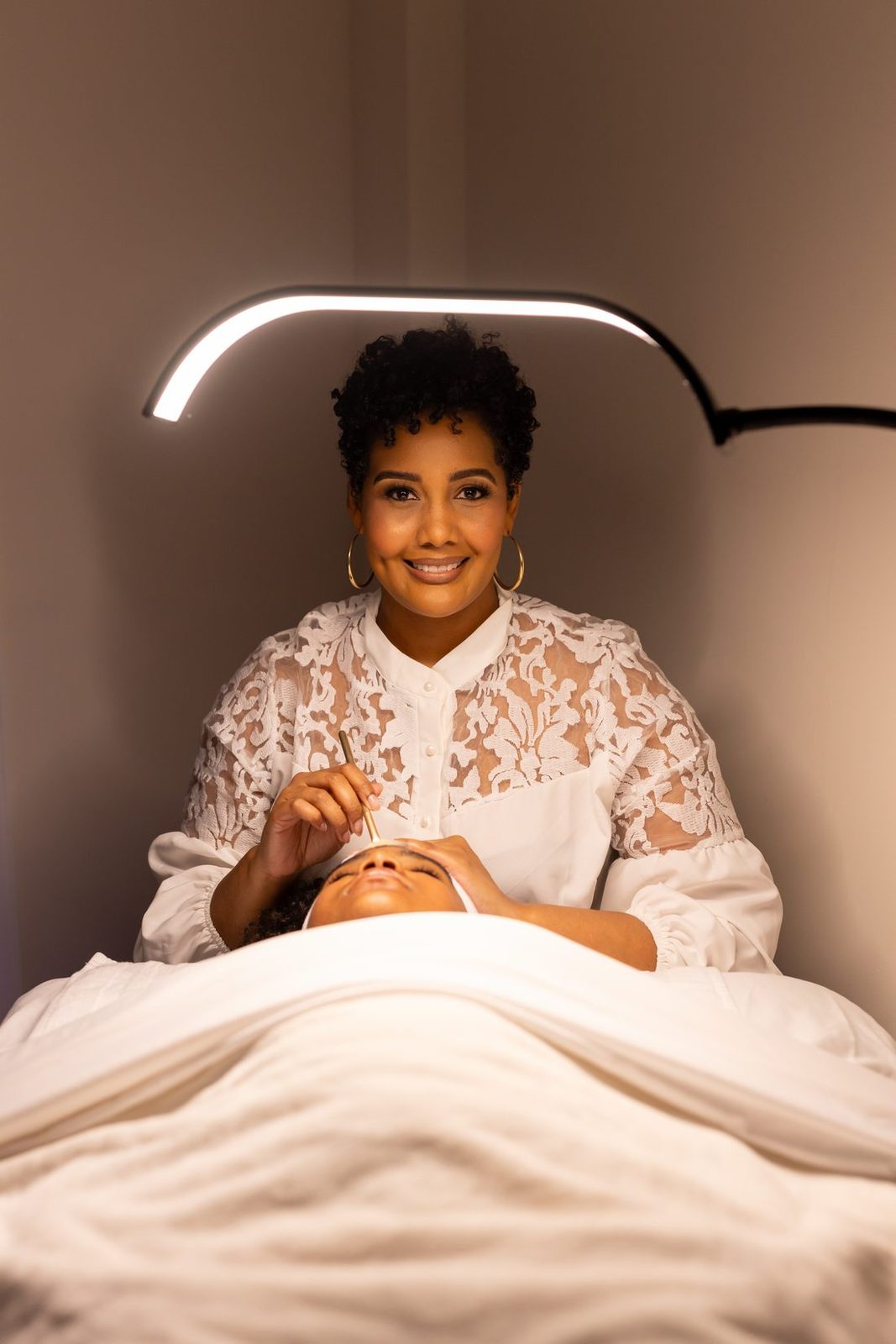

When I was dealing with my own skin, the hardest part was never the skin. It was finding someone I could trust to treat it.
If you've lived in melanin-rich skin, you might already know the feeling. Maybe you have PCOS — so many of us do — and you're managing unwanted facial hair, and the ingrown hairs and dark spots that come with it. Maybe it's acne, and the dark marks it leaves behind that last far longer than the breakout ever did. Maybe it's cratered scars, or hyperpigmentation that no one could explain to you. So you go looking for help.
And too often, the person across from you doesn't look like they understand your skin at all.
For a long time, there weren't even lasers that could treat our skin without burning it. I'm not speaking in metaphor — the technology itself was built and tested on lighter skin, and ours paid for that gap in burns and scarring. But the deeper wound was quieter than that. It was being handed a tretinoin prescription with no explanation — no one telling you it would leave you flaking unless you learned to buffer it, no one warning you that getting your eyebrows waxed while you used it could tear off an entire layer of skin. It was being told to exfoliate, and exfoliate, until your barrier was stripped raw — and no one ever mentioning that more was the problem. It was an aggressive facial that sent me home worse than I walked in.
The list goes on, and most of us could add to it. Underneath every item on it was the same silence: no one ever told you why your skin did what it did, or what the actual plan was to fix it.
So you leave. With more problems than you came in with, less confidence than you had before, and a bag of products you have no idea will even work.
And when the people who are supposed to help you keep failing you, you start helping yourself. I get why so many of us end up mixing our own products at home — no preservatives, no testing, no idea what we're doing — and grow mold and bacteria into brand-new problems on top of the old ones. That's not recklessness. That's what happens when a whole industry leaves you to figure it out alone.
Here's what took me a long time to understand:
For most of its history, both medicine and the beauty industry were built around lighter skin. Dermatology textbooks underrepresented darker skin, so providers trained on images that looked nothing like the clients in their chairs. Products and shade ranges were designed for fairer tones first, and everyone else second — if at all. Professional education taught skin as though it came in one default setting. So when a melanin-rich client walks in already a little guarded — will this person actually know my skin, or will they dismiss me again? — that wariness isn't difficult. It's earned.
And we treat skin like it stops at the jaw. We talk about the face and quietly forget the rest of us — the back, the chest, the buttocks — skin that breaks out and scars and carries hyperpigmentation just the same, but that we're too embarrassed to bring up, and that half the time doesn't even appear on a treatment menu. Meanwhile the shelves overflow with products, most of them never touched by an actual skincare specialist, and you're left to guess which one — if any — was ever made with your skin in mind.
The thing is, melanin-rich skin isn't harder to care for. It's just different, and that difference is knowable. Our skin tends to respond to inflammation by making pigment — which is exactly why an aggressive treatment can leave a dark mark that lasts for months. Once you understand that one truth, almost everything else follows: go gentler, protect from the sun, explain the why, and never trade a breakout for a year of hyperpigmentation. It isn't a mystery. It's a skill set. It simply hasn't been treated as one.
So I decided to treat it as one.
The Melanated Skin Registry exists to close the gap I spent years falling into.
It's two things. First, it's a directory — a place where you can actually find professionals who understand melanin-rich skin, vetted, so you're not rolling the dice on whether the person treating you has ever seen skin like yours.
Second — and this is the part I'm proudest of — it's a real standard. We built a certification called Pigment-Aware Certified™: six modules covering how melanin-rich skin actually works, post-inflammatory hyperpigmentation, procedure safety, the conditions that show up differently on our skin, hair and scalp considerations, and the cultural competency that makes a client feel seen instead of tolerated. It ends in an honest assessment, and the credential is one anyone can verify. Not a participation trophy. A standard you have to earn.
I want to speak to two people reading this.
If you're someone who's been failed before — who's left an appointment with less confidence than you arrived with — I want you to know the problem was never your skin, and it was never you. You deserve a professional who can look at your skin, tell you what's happening and why, and give you a plan you understand. That's not a luxury. That's just good care. We built this so you can find it.
And if you're a professional reading this — there's a good chance you found this field the same way so many of us did: through your own skin. The breakouts, the marks, the years of searching for someone who finally understood — that's the origin story behind a lot of the best people in this work. Which means you already know exactly what's at stake when a client sits in your chair hoping this time will be different. This is an invitation. There are clients searching right now for someone exactly like you, and no good way to find each other. Meet the standard, and let them find you. Becoming Pigment-Aware Certified says something plainly that's been left unsaid for too long: I see this skin, I understand it, and you can trust me with it.
I think often about how different my own journey would have been if a place like this had existed — if I could have searched, found someone who understood, and walked out for once with answers instead of new problems.
I couldn't go back and give myself that. But I could build it for the next person.
That's what this is. A standard for skin that has gone too long without one — and a promise that here, finally, you'll be seen.
— Tamara Jones, Founder